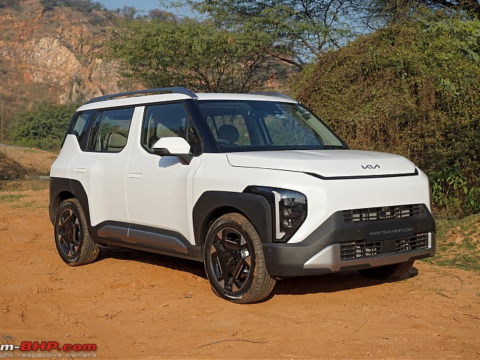
Test drove the Syros Turbo petrol DCT today. Here are some key observations
BHPian PB65 recently shared this with other enthusiasts:
1. Looks like a beefed-up Exter. Quite polarising. But the alloy wheels are a stunner.
2. Headlamp positioning reflects lame product planning or malfeasance. For something built for India, this should have been a top criterion while designing the car. The sales guy gave me all sorts of explanations, ranging from toughened material for the headlamps to ADAS, as an effort from Kia to protect the headlamps.
3. Side profile and rear look stunning, but that’s a personal perspective.
4. Interiors is where Kia has nailed it. Great quality everywhere. Germans are losing ground in this aspect now.
5. Couldn’t get comfortable in the driver’s seat. The Seat Base was good, but the backrest was too narrow and snug for my 3-month rest from the gym frame. Feels like it was developed for Koreans with lean upper bodies and long legs. The mid-back support also felt odd.
6. Driving position again, couldn’t get that right. I prefer a Honda/BMW-like driving position with everything within reach and steering at the mid-upper chest level. Syros felt more like a Bolero. Low slung steering, high set seats, and legs at an almost perpendicular angle.
7. Steering has manual adjustment, and the adjustment range is healthy.
8. Seats have a healthy range of adjustment. Height adjust is manual; fore-aft travel and backrest adjust are electric.
9. For a Harman Kardon-branded system, the music system simply lacks depth. Either it’s this or I had way higher expectations after being spoiled by Tata cars.
10. Even with a 5-star BNCAP rating, something felt off with the car’s build. The Dzire feels sturdier in comparison. Syros just didn’t inspire confidence.
11. Rear seats are a gem. The backrest can be reclined at a healthy angle for a comfortable snooze. Seats travel fore and aft as well. Cushioning is also great, although on the firm side. It should be good enough for long journeys.
12. Seat Ventilation at the rear is only for the seat base. Honestly, couldn’t feel it working.
13. This brings us to the AC, which felt weak compared to other Hyundai/Kia cars. Buyers are advised to test this in particular, especially when sitting in the rear.
14. Boot space ranges from 390L to 465L, depending on the backrest angle of the back seat.
15. Direct injection Turbo petrol makes 120hp and 172 Nm. There’s some lag below 1500-1800 RPM, but by Turbo petrol standards, it’s quite tractable.
16. The engine surprisingly redlines somewhere just above 5000 RPM. The National Diesel Engine of India used to do that.
17. The gearbox is tuned for a relaxed driving style. Stomp the accelerator and you can hear the engine protest. Paddle shifters are there, but they only help so much.
18. Suspension is firm. This, combined with what I feel is a questionable build, makes it thud over potholes, and you can actually hear that Hollow build. Still, the ratings say 5-star safety, so that’s a respite.
19. There are 3 driving modes: Eco, Normal, and Sport. You can actually feel some difference in the engine responses. Automatic variants get three traction modes: Sand, Mud, Snow. Couldn’t test these.
20. Overall, it feels like a better buy compared to Sonet, but priced dangerously in the Seltos territory. All the gizmos, ADAS (I prefer to have that switched off), and interior flexibility do justify that to some extent, but then again, would you buy this over the Seltos?
Check out BHPian comments for more insights and information.